Skip to content
CareerGauge
How It WorksPricingHelp
Log inAnalyze a Job

How it works

From first capture to final outcome.

A job search is not one action. CareerGauge keeps the source, decisions, and work around an opportunity connected from the moment you find it to the final result.

The CareerGauge career lifecycle

  1. 1

    Understand

    Build your career baseline

  2. 2

    Capture

    Save the opportunity

  3. 3

    Evaluate

    Analyze the opportunity

  4. 4

    Decide

    Pursue, hold, or close

  5. 5

    Prepare

    Build the application packet

  6. 6

    Manage

    Track interviews and follow-up

  7. 7

    Learn

    Preserve outcomes and history

Step 1 | Understand

Build your professional baseline.

Turn your resume and professional context into evidence you can use for better decisions.

What you provide

  • Resume
  • Career goals
  • Preferences
  • Constraints

What CareerGauge creates

  • Structured professional context
  • Career Insights

What it enables

  • Future opportunities can be evaluated against the same baseline

Step 2 | Capture

Bring in the opportunity your way.

Capture an opportunity from the web or enter it directly in CareerGauge. Save it first, or analyze it against your professional baseline when you are ready.

Browser capture

  • Open the Chrome extension
  • Review the detected job
  • Save or Save & Analyze

CareerGauge web input

  • Enter or paste the opportunity
  • Review the source information
  • Save or start analysis

One result

  • A captured opportunity with source context
  • Analysis remains optional
Add to ChromeLearn about browser capture

Chrome extension

Capture the job from the active page while you browse.

CareerGauge web app

Enter or paste opportunity information directly in CareerGauge.

Step 3 | Evaluate

Analyze a real opportunity.

When you choose to analyze, compare the saved opportunity against your professional evidence—not generic keyword similarity.

What you provide

  • A job description or captured opportunity

CareerGauge examines

  • Requirements
  • Evidence
  • Gaps
  • Constraints
  • Available context

What you receive

  • A Decision Brief

Step 4 | Decide

Choose where the effort is worth investing.

Review why an opportunity appears worth pursuing—or why it may not be. CareerGauge surfaces evidence, uncertainty, and the factors that could materially change the recommendation.

Explore career decisions

Pursue

Strong fit and worth the investment.

Hold

Some potential; more information needed.

Close

Not a strong fit right now.

Rationale for this opportunity

  • Evidence grounded in your experience.
  • Constraints and uncertainty stay visible.
  • A practical next move follows the decision.

Step 5 | Prepare

Build the application in context.

Working documents can evolve. Submitted packets preserve what was actually sent, connected to the opportunity and its decision.

Master Resume

Your complete professional history

Tailored Resume

Adapted for this opportunity

Cover Letter

Aligned to the role and your narrative

Application Packet

The documents you actually submitted

Explore applications and documents

Step 6 · Manage

Keep the pursuit connected.

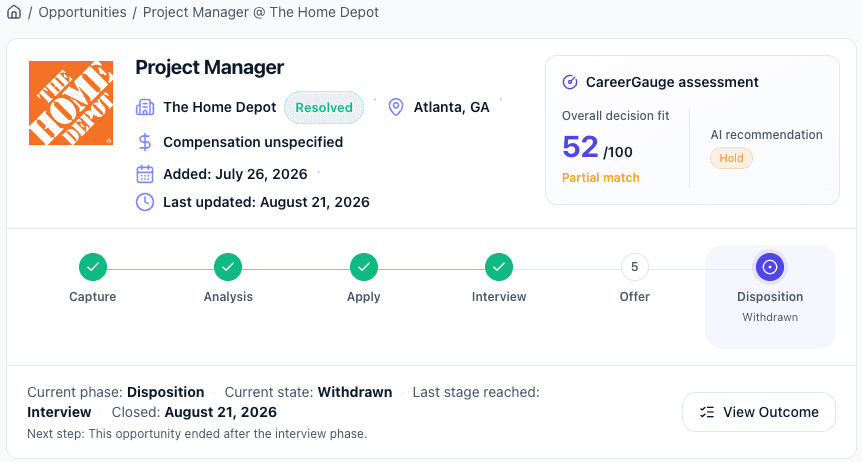
One opportunity becomes the context for the work it may lead to: your analysis, documents, conversations, interviews, and progress.

Decision Brief

Analysis and recommendation

Documents

Resume, cover letter, more

Contacts

People and conversations

CareerGauge opportunity workspace showing a completed opportunity and its progress from capture through disposition.

Interviews

Rounds, feedback, notes

Follow-up

Tasks and reminders

Outcome

Results and key learnings

Step 7 | Learn

Preserve what happened.

Record the result and the context around the pursuit so the next search does not begin without history.

Explore interviews and follow-up

Outcome

Record whether you pursued, passed, withdrew, or received an offer.

Timeline / history

Preserve the decisions and events that brought the opportunity to its result.

Key notes

Keep the context and reflections that make the history useful later.

The same opportunity context follows you through the lifecycle.

The CareerGauge career lifecycle

  1. 1

    Understand

    Build your career baseline

  2. 2

    Capture

    Save the opportunity

  3. 3

    Evaluate

    Analyze the opportunity

  4. 4

    Decide

    Pursue, hold, or close

  5. 5

    Prepare

    Build the application packet

  6. 6

    Manage

    Track interviews and follow-up

  7. 7

    Learn

    Preserve outcomes and history

Start with a real career question.

Evaluate a specific opportunity or begin by understanding your professional baseline.

Choose your starting point

Both paths retain the same evidence-backed context as your search progresses.

Analyze a JobAudit My Resume
CareerGauge

Evidence-backed career decisions for professionals evaluating opportunities and planning their next move.

Product

  • Career Baseline
  • Career Decisions
  • Job Search Management
  • Chrome Extension
  • Applications & Documents
  • Interviews & Follow-up
  • Pricing

Free Tools

  • Analyze a Job
  • Audit My Resume

Resources

  • How It Works
  • Help
  • Chrome Extension Help
  • System Status

Legal

  • Terms of Service
  • Privacy Policy

© 2026 CareerGauge. All rights reserved.

View system status